WeLCOME TO RAVINA INDUSTRIES MANUFACTURER & eXPORTER of linkage parts

Buy Tractor 3 Point Hitch Linkage Parts Direct from Manufacturer – Complete Buyer’s Guide blog post
The Three-Point Linkage System is a critical component of modern tractors that allows farmers to attach and operate a wide range of agricultural implements such as ploughs, cultivators, harrows, and seed drills. Because these components handle heavy loads and continuous field operations, using high-quality 3 point hitch linkage parts is essential for reliable performance and long service life.www.rwpagriparts.com
SHIMON SUBHRAI
4/5/20263 min read
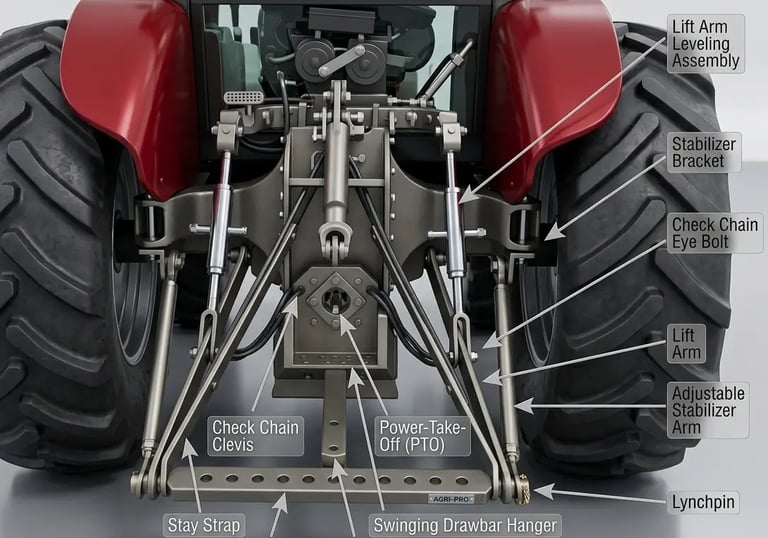
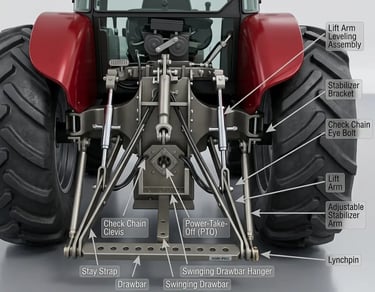
Complete Parts Guide: 3 Point Linkage Parts System
The Three-Point Linkage System is one of the most important mechanisms used in modern tractors. It allows tractors to connect with agricultural implements such as ploughs, cultivators, seed drills, and harrows. The system uses a triangular structure formed by three connection points, providing excellent stability, weight distribution, and control of attached equipment.
This system was originally developed by Harry Ferguson, and today it is a universal standard used in tractors worldwide. The efficiency of the system depends on several important parts working together. Below is a complete guide to the key 3 point linkage parts and their functions.
1. Top Link
The Top Link is the upper central link of the linkage system. It connects the top point of the tractor hitch to the implement.
Function:
Controls the angle and tilt of the implement.
Helps maintain proper alignment during operation.
Allows adjustment for different types of implements.
Top links are usually adjustable in length to ensure correct positioning of agricultural equipment.
2. Lower Link Arms
The Lower Link Arms are the two strong arms located on both sides of the tractor. These arms connect directly to the implement.
Function:
Carry most of the implement weight.
Provide lifting support through the tractor’s hydraulic system.
Maintain stability during field operations.
These arms are one of the strongest parts of the linkage system.
3. Lift Arms
Lift Arms are connected to the tractor’s hydraulic lift system and help raise or lower the lower link arms.
Function:
Allow the tractor operator to lift or lower attached implements.
Provide precise depth control during farming operations.
Improve operational efficiency.
Hydraulic lift arms make modern tractors much easier to operate compared to older manual systems.
4. Lift Rods
Lift Rods connect the lift arms to the lower link arms.
Function:
Transfer lifting motion from the hydraulic system.
Help maintain balance between both sides of the linkage.
Allow height adjustments for proper implement alignment.
Some lift rods are adjustable to correct uneven lifting.
5. Stabilizers (Sway Bars)
Stabilizers, also known as sway bars, limit the side-to-side movement of the implement.
Function:
Prevent excessive swinging of equipment.
Maintain straight-line operation in the field.
Improve safety and control during transport.
These parts are particularly important when working on uneven terrain.
6. Check Chains
Check Chains provide additional stabilization to the lower link arms.
Function:
Restrict lateral movement.
Keep implements properly aligned behind the tractor.
Protect the linkage system from excessive stress.
They are commonly used together with stabilizers.
7. Ball Ends
Ball Ends are spherical joints located at the ends of the lower link arms and top link.
Function:
Allow flexible movement between tractor and implement.
Reduce stress on linkage parts.
Enable smooth operation when working on uneven ground.
Ball ends are designed for durability and long service life.
8. Linkage Pins
Linkage Pins are heavy-duty pins used to secure implements to the linkage arms.
Function:
Hold the implement firmly in place.
Allow quick attachment and detachment.
Ensure safe operation.
These pins are usually hardened steel for strength and reliability.
9. Brackets and Mounting Components
Brackets and mounting parts support the entire linkage assembly on the tractor.
Function:
Provide structural support.
Secure linkage arms to the tractor body.
Maintain proper alignment of components.
Strong mounting brackets ensure the system can handle heavy agricultural implements.
Importance of the 3 Point Linkage System
The Three-Point Linkage System revolutionized modern farming by making it easier to attach, control, and operate agricultural equipment. It improves efficiency, reduces manual effort, and enhances tractor versatility.
Key benefits include:
Better implement control
Improved safety during operation
Faster attachment and removal of implements
Increased farming productivity
Because of these advantages, the system has become a global standard in Agricultural Engineering.
Conclusion
Understanding the different parts of the 3 Point Linkage System is essential for farmers, tractor owners, and agricultural machinery manufacturers. Each component—from the top link to stabilizers—plays a critical role in ensuring smooth operation and efficient power transfer between tractors and implements.
High-quality linkage parts are vital for durability, safety, and long-term performance. Manufacturers like Ravina Industries specialize in producing reliable linkage components designed to meet international agricultural machinery standards.
By maintaining and selecting the right linkage parts, farmers can significantly improve the efficiency and productivity of their tractor operations.