WeLCOME TO RAVINA INDUSTRIES MANUFACTURER & eXPORTER of linkage parts

✈️ Air Freight
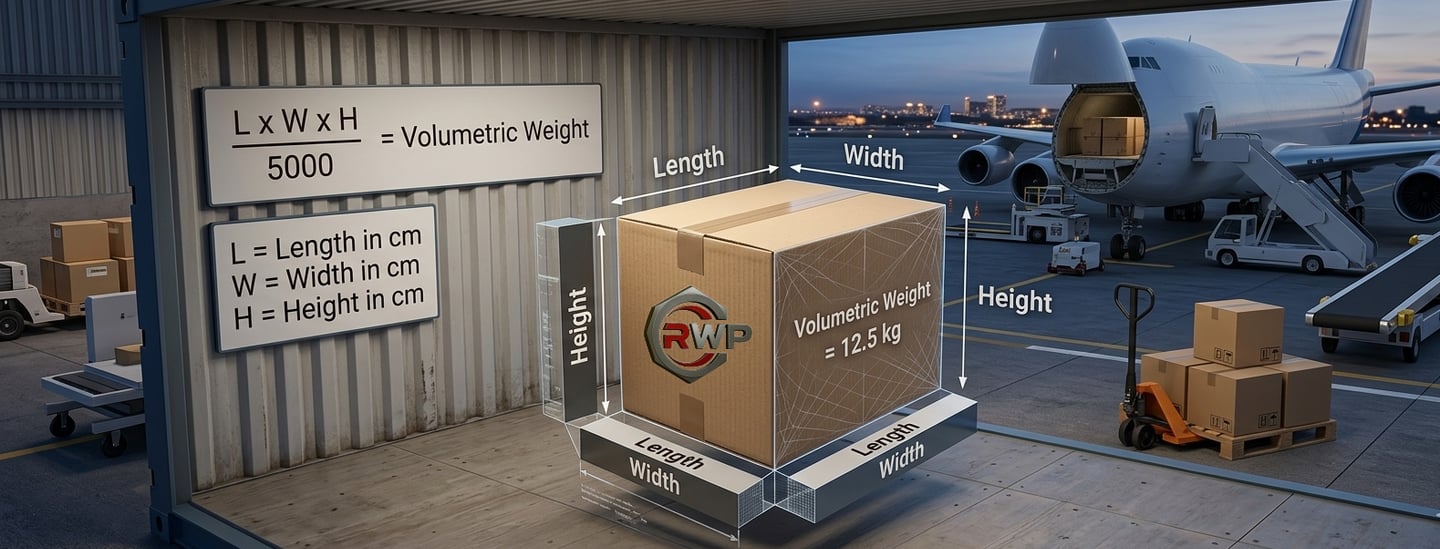
Air freight operates on a 1:6 density ratio, meaning the volumetric weight is calculated by dividing the package dimensions (in centimeters) by 6,000 and multiplying by the number of packages. For example, with dimensions of 120 × 80 × 50 cm and 2 packages, the volumetric weight comes to 160 kg. Air freight is ideal for urgent shipments, lightweight cargo, and high-value goods where speed and reliability are critical.
🚢 Ocean Freight (LCL)
Ocean freight under Less-than-Container Load (LCL) uses a 1:1 density ratio, where the volume is divided by 1,000. For the same shipment dimensions and quantity, the volumetric weight is 960 kg, which is significantly higher compared to air and rail. This mode is best suited for heavy, bulky, and non-urgent shipments. In the case of Full Container Load (FCL), charges are based on container size rather than volumetric weight.
🚆 Rail Freight
Rail freight follows a 1:3 density ratio, calculated by dividing the volume by 3,000. For the given shipment, this results in a volumetric weight of 320 kg. Rail transport offers a balanced solution between cost and transit time, making it suitable for medium-weight shipments that are not as time-sensitive as air freight but require faster delivery than ocean freight.
Calculating Chargeable Weight by Air, Ocean, Road and Rail
Knowing Your KG from Your CBM
When shipping goods across different transport modes such as air, ocean, road, or rail, understanding how chargeable weight is calculated is essential for accurate cost estimation. Freight carriers do not rely solely on the actual weight of your cargo. Instead, they compare two values — actual weight (KG) and volumetric weight (derived from CBM) — and apply the rule of “whichever is greater” (also known as the carrier’s choice).
This means that even if your shipment is lightweight but occupies a large volume, you may be charged based on its space rather than its physical weight. Volumetric weight is calculated using the shipment’s dimensions (Length × Width × Height), which are then converted into kilograms using a specific divisor depending on the mode of transport.
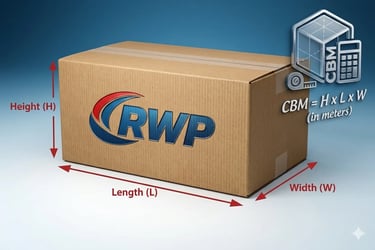
For air freight, the standard divisor is 6,000, making it more sensitive to bulky shipments. Ocean freight (LCL) typically uses a 1:1 ratio (1 CBM = 1,000 kg), which can result in significantly higher chargeable weight for large cargo volumes. Rail freight generally applies a 1:3 ratio, offering a balance between cost and efficiency, while road freight may vary depending on the transporter but often follows similar volumetric principles.
To determine your chargeable weight, calculate both the actual weight and the volumetric weight, then select the higher value. This ensures that carriers are compensated fairly for both the weight and the space your shipment occupies during transit.
Understanding this concept helps businesses plan logistics more efficiently, optimize packaging, and avoid unexpected freight costs. Whether you are exporting machinery parts, agricultural components, or industrial goods, knowing your KG from CBM is a key step toward smarter shipping decisions.